Business
HavocAI raises $85M to sell autonomous boats to the U.S. military

In the aftermath of the passage of President Trump’s Big Beautiful Bill—which set aside billions of dollars for rapid prototyping and integrating artificial intelligence systems for the Defense Department—startups are in a mad dash to raise capital so they can compete for the funding.
One of those companies is HavocAI, a Rhode Island-based startup that demonstrated its autonomous vessels just last summer and is already selling boats to the U.S. military and its allies. HavocAI closed an $85 million venture funding round at the end of September so that it can be prepared to manufacture thousands of autonomous boats and incorporate its autonomous tech stack into new types of vessels at a moment’s notice, its CEO and cofounder, Paul Lwin, tells Fortune.
“When the Reconciliation Bill came out, all of our existing investors said: Hey, don’t go and try to raise money and take six months doing it. They said: You need to run fast,” Lwin says.
HavocAI put together the new round within three months, Lwin said—bolstering the startup’s total funding raised to nearly $100 million since the company launched just last January. This most recent round—which included the venture capital firms B Capital, Up.Partners, Scout Ventures, and Outlander Ventures; the CIA’s venture capital arm, In-Q-Tel; defense behemoth and strategic partner Lockheed Martin; and Taiwan’s public and private venture capital fund, Taiwania Capital—will position the startup to compete for a piece of the more than $3.3 billion that the new legislation set aside specifically for the development of medium and small unmanned surface vessels. Lwin declined to provide a valuation.
HavocAI’s strategy is all about manufacturing speed and affordability, Lwin says. U.S. military leadership has for years complained about the lengthy—and costly—process of building ships in the U.S. It can take years and hundreds of millions of dollars for contractors to build a ship for the U.S. Navy. A medium-sized naval vessel, for example, like a frigate, can take somewhere around six years to manufacture, compared to the typical one to two years of a commercial ship—largely due to advanced technology and more-stringent and mission-specific requirements.
But Lwin says that commercial boats would work just fine in the defense sector, too. “The boat isn’t what you need to reinvent,” he says. “What you need to invent is technologies to make these boats into robots and connect them to each other,” he says.
HavocAI is working with commercial boat manufacturers to build HavocAI standard-sized boats, then to retrofit those vessels with its autonomous software—using AI algorithms and perception models similar to what you would see on a self-driving car.
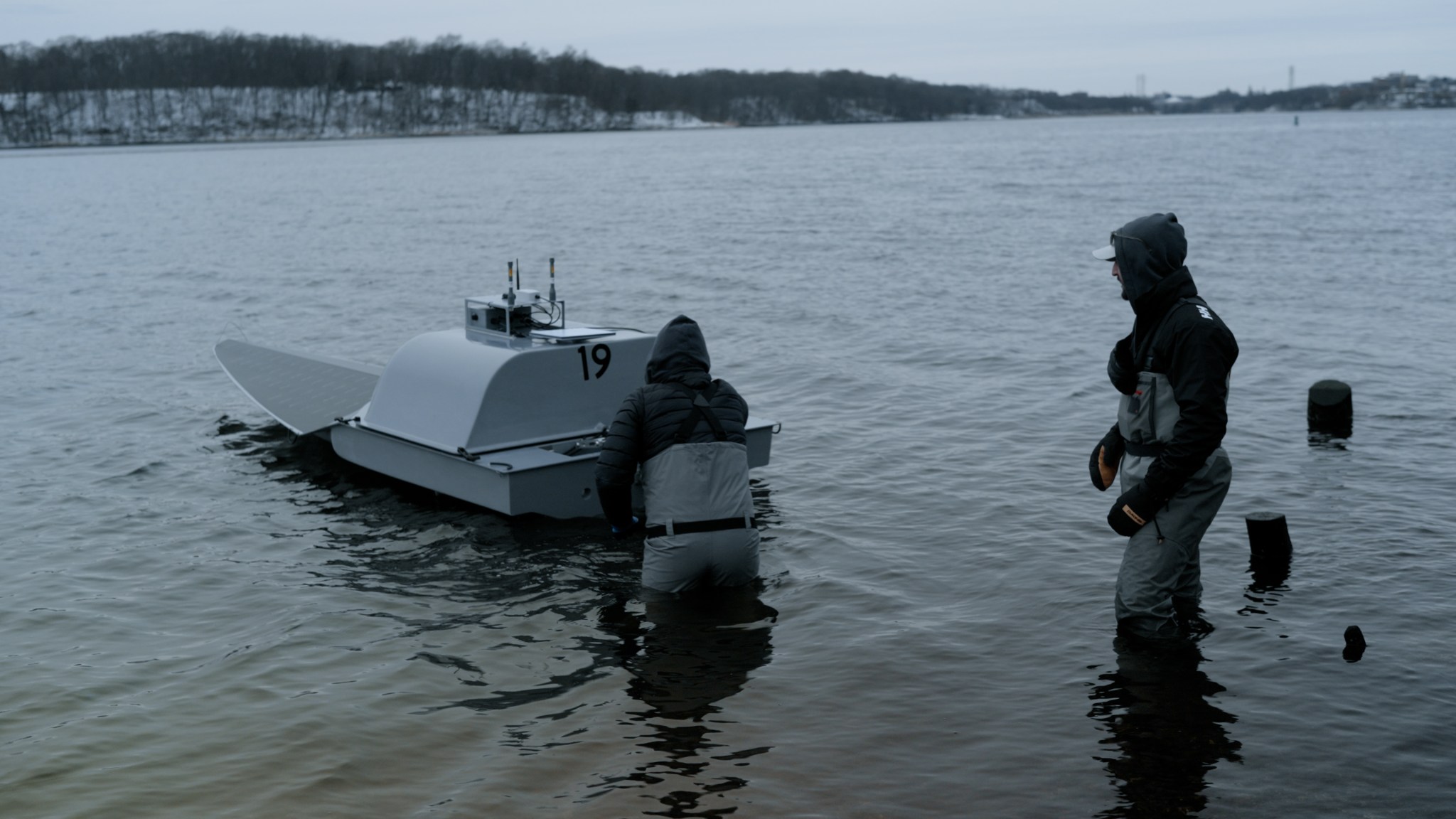
HavocAI debuted its product for the first time last summer at “Silent Swarm,” a two-week experimentation event hosted by the Navy. After the event, the Navy immediately purchased a dozen of HavocAI’s initial 14-foot “Rampage” vessels for $100,000 a piece, Lwin says.
“We want our vessels to be priced similar to munition prices, where if you expend these, or you use them, or they get blown up, it’s not a big deal—you still have thousands of them,” Lwin says. “The price point is part of the product for the Rampage vessels,” he says, though he points out that larger vessels—such as what HavocAI has started working on with Lockheed Martin—will be more expensive.
Since the Silent Swarm, HavocAI has started operating another 20 more of its boats as a contractor for the U.S. Army, Navy, and Defense Innovation Unit, and it has begun to incorporate its tech into a 38-foot Seahound vessel and a 42-foot Kaikoa, according to the company. HavocAI is currently testing a single 100-foot “Atlas” vessel on the water in Rhode Island.

Lwin and his cofounder Joe Turner both have backgrounds in the military. Lwin, a Myanmar refugee who came to the U.S. with his family when he was 10 years old, flew EA-6B Prowlers for the Navy. Turner, the COO of HavocAI, was formerly a naval surface officer before cofounding an autonomous systems company, where Lwin would also serve as Chief Technology Officer. The two of them cofounded HavocAI in January 2024.
Lwin envisions the Navy and U.S. allies being able to use the boats to create a distributed sensor network across thousands of vessels, so that militaries can have better visibility into large geographic areas. He says that the Army and the Marine Corps could also use the 14-foot boats to move up to 300 pounds of supplies without putting people at risk. Poland is apparently testing HavocAI boats in order to potentially gather intelligence against Russia in the Baltic Sea.
Since starting the company last January, HavocAI has grown to 80 people. Boat builder Metal Shark announced Thursday that it was incorporating HavocAI’s autonomous platform across its existing fleet of unmanned surface vessels.
HavocAI was one of a series of American defense tech companies, including RapidFlight, Kratos Unmanned Aerial Systems, and Cyberlux, that were sanctioned by China at the end of the last year for selling U.S. arms to Taiwan. There are now several autonomous boat startups that have popped up to compete in the market, including Blue Water Autonomy.