Business
The AI wave: For a maximalist, things couldn’t be better


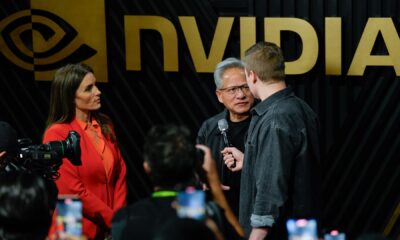
The world is in the midst of an AI wave that is driving unprecedented transformation: the creation of globe-spanning computing systems for Artificial Intelligence. McKinsey estimated this massive infrastructure project will cost $7 trillion in the next five years. Nvidia just announced plans to invest up to $100 billion in OpenAI to build out a new generation of AI data centers, one of the largest AI computing projects in history. These are remarkable numbers that get even bigger when you consider the countless supporting projects, like many subsea cables, or local corporate and public sector computing projects, that will likely be essential for this global AI network.
But the really astonishing thing is that we are building this to upend much of our world. Here’s why I think that’s great.
I am a strong proponent of so-called “maximal thinking”: intuiting a means to change, and taking the new idea to its greatest useful expression. This has long been a wellspring of great innovation, and is why much of the so-called “disruptive innovation” we’ve seen in many industries comes from outsiders. The infrastructure we’re building today will spark a maximalist boom.
I’m not sure anything like it has happened before. The great infrastructure projects of the last century included airports, transnational highways, and deep water harbors that accommodated cargo containers. These accelerated international trade and enabled things like outsourcing and same-day delivery, with dramatic results in countries as (initially) different as the U.S. and China. In the 1800s, the investments in railroad infrastructure increased migration to a mass level, transformed the American Midwest to an agricultural powerhouse, and allowed Imperialist powers to grow across Africa and the Indian subcontinent.
In all of these cases, the investments paid off primarily by scaling up existing powers and processes. There were discontinuous shocks, of course, like when militaries encountered industrialized violence at the start of World War I, or how government-sponsored computer networks gave way to the Internet. The intentions in the previous investments were initially linear, building on what was already there.
Compare that to today, when AI is scaled up specifically to disrupt and change things. Our global AI build will likely spark new industries in robotics, bioengineering, and computation. Today’s self-driving taxis, rapid vaccine manufacture, and telepresence-based economies are just the earliest signs of this discontinuous change. We are, for the first time in history, creating major infrastructure not simply to expand what we know, but to spark nonlinear innovation on a massive scale.
Knowledge as a commodity
This infrastructure investment is already producing a dramatic result: generative AI is rapidly turning knowledge itself into a commodity. Proficiencies that took years and decades to develop can now be replicated in moments by AI. This challenges traditional paths to expertise. One need only look at this year’s crises in universities and the slowdown in hiring entry-level graduates for a sense of this.
People will adapt, but with some difficulty. Machines already do more things, in ways we didn’t imagine even at the start of this decade. While you can point to AI-based hallucinations that seem to make a joke of this, it is good to be reminded: A lot of very smart people are committing $7 trillion to making the new systems even bigger, more powerful, and more accurate. Gen AI is the cutting-edge technology today, but part of today’s investment is in developing even more powerful forms of AI.
Some people despair that humans will render themselves largely irrelevant thanks to big machines, and most will have no means to seek their own meaning and fulfillment through work. To them, the networked sky is falling, and not just from data center-connected satellites.
I believe the opposite: If knowledge is commoditized, it doesn’t mean it is valueless. Other commodities, like petroleum and agricultural products, have fallen in price and found new, large markets, becoming more valuable. The commoditization of knowledge means people will interact with it in new ways, connecting previously unrelated things to create new insights and outcomes that generate value.

As knowledge becomes a commodity, more people will be able to access it. This will free us to apply our own experience, intuition, and imagination —valuable, uniquely human qualities that AI can’t replicate.
A new model is emerging
For a maximalist, things couldn’t be better. Industry insiders, bound by existing rules, often struggle to adapt during major shifts. It usually takes outsiders, intuiting new possibilities, to make progress. Now, with the latest AI knowledge unlocked, we have far more of these productive outsiders ready to move industries forward.
It’s not that the old model is broken—it’s just no longer appropriate for this new world. A new model is emerging. The new infrastructure will empower more thinkers to intuit new possibilities and build out new systems. Often, they’ll do it by locating new data and facts about the world that don’t exist inside the AI, and that, too, will give them an edge.
For company leaders in a reconfigured knowledge era, where originality and intuition are the ultimate edge, there will be fascinating management challenges. The questions are no longer just about efficiency, but about strategy: How can I cultivate more original thinkers? How can my teams connect dots in new ways? How can we hold to a core value proposition while also expanding it into new areas, facing a changing future with optimism?
For a maximalist, it’s going to be a great time.
The opinions expressed in Fortune.com commentary pieces are solely the views of their authors and do not necessarily reflect the opinions and beliefs of Fortune.