Business
Trump promises ‘so much critical mineral and rare earth that you won’t know what to do with them’ after signing $8.5b deal with Australia

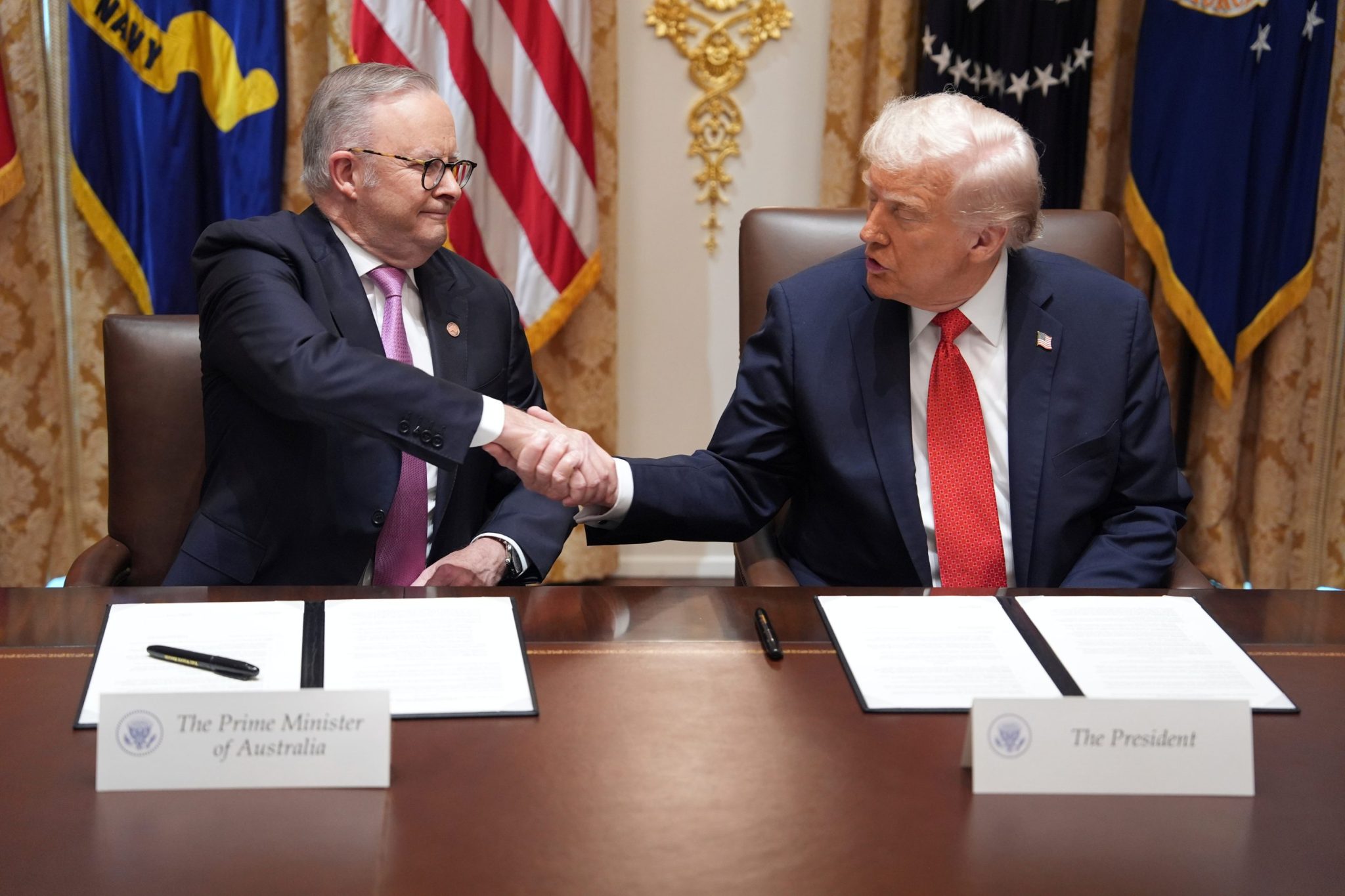
President Donald Trump and Australian Prime Minister Anthony Albanese signed a critical-minerals deal at the White House on Monday as the U.S. eyes the continent’s rich rare-earth resources at a time when China is imposing tougher rules on exporting its own critical minerals abroad.
The two leaders described the agreement as an $8.5 billion deal between the allies. Trump said it had been negotiated over several months.
“In about a year from now we’ll have so much critical mineral and rare earth that you won’t know what to do with them,” said Trump, a Republican, boasting about the deal. “They’ll be worth $2.”
Albanese added that the agreement takes the U.S.-Australia relationship “to the next level.”
Earlier this month, Beijing announced that it will require foreign companies to get approval from the Chinese government to export magnets containing even trace amounts of rare-earth materials that originated from China or were produced with Chinese technology. The Trump administration says this gives China broad power over the global economy by controlling the tech supply chain.
“Australia is really, really going to be helpful in the effort to take the global economy and make it less risky, less exposed to the kind of rare earth extortion that we’re seeing from the Chinese,” Kevin Hassett, the director of the White House’s National Economic Council, told reporters Monday morning ahead of Trump’s meeting with Albanese.
Hassett noted that Australia has one of the best mining economies in the world, while praising its refiners and its abundance of rare earth resources. Among the Australian officials accompanying Albanese are ministers overseeing resources and industry and science, and Australia has dozens of critical minerals sought by the U.S. because they are needed in everything from fighter jets and electric vehicles to laptops and phones.
A push for more mines
The agreement could have an immediate impact on rare earth supplies in the United States if American companies can secure some of what Australian mines are already producing, although it will take years — if not decades — to develop enough of a supply of rare earths outside of China to reduce its dominance.
Pini Althaus, who founded USA Rare Earth back in 2019 and is now working to develop new mines in Kazakhstan and Uzbekistan as CEO of Cove Capital, said it will be crucial that the contracts to buy materials from Australian mines include price floors, similar to what the U.S. government promised MP Materials this summer, to protect against China manipulating prices.
For decades, China has used the tactic of dumping excess critical minerals onto the market to drive prices down to force mining companies in the rest of the world out of business to eliminate any competition.

“I think taking away that arrow in the quiver of China to manipulate pricing is an absolute crucial first step in Australia and the West being able to develop critical minerals projects to meet our supply chain demands,” said Althaus, who has spent nearly a quarter-century in the mining business.
The agreement underscores how the U.S. is using its global allies to counter China, especially as it weaponizes its traditional dominance in rare earth materials. Top Trump officials have used the tactics from Beijing as a rallying cry for the U.S. and its allies to work together to try to minimize China’s influence.
“China is a command-and-control economy, and we and our allies will neither be commanded nor controlled,” Treasury Secretary Scott Bessent said last week. “They are a state economy and we are not going to let a group of bureaucrats in Beijing try to manage the global supply chains.”
The level of investment outlined in the agreement shows how serious the two nations are about addressing the problem.
“The U.S. and Australia will invest over $3 billion in joint critical minerals projects within six months. That’s a somewhat unprecedented speed of capital injection,” said Gracelin Baskaran, director of the Critical Minerals Security Program at the Center for Strategic and International Studies in Washington.
But Althaus cautioned that Australia can’t supply everything the United States needs, so it is crucial that American continues to invest in the long-term effort to develop other mining and processing projects both at home and in friendly nations. He said central Asia might be one of the most promising places to invest because the region has significant rare earth reserves, and the Soviet Union already did some of the initial development work when it controlled that territory. That could cut years off the time it will take to build a new mine there.
“Keep in mind, China has almost a 40-year head start on us,” Althaus said. “We have at least a couple of decades to catch up to China in terms of being able to meet our own supply chain requirements.”
Albanese’s visit comes just before Trump is planning to meet with Chinese President Xi Jinping in South Korea later this month.
The security partnership
Another topic of discussion was AUKUS, a security pact with Australia, the U.S. and the United Kingdom that was signed during U.S. President Joe Biden’s Democratic administration.
Trump noted Monday that AUKUS was established “a while ago” but that the agreement now is “moving along very rapidly, very well.” Albanese said that “our defense and security partnership with AUKUS is so important for us.”
John Phelan, the Navy secretary, said that the U.S. wants to take the original AUKUS framework and improve it for the three signatory countries while clarifying “some of the ambiguity” in it.
“So it should be a win-win for everybody,” Phelan said.
In Beijing, the Chinese government reiterated its opposition to the pact, which would help Australia obtain and build nuclear-powered submarines.
“We always oppose creating bloc confrontation, increasing nuclear proliferation risks and intensifying an arms race,” Foreign Ministry spokesperson Guo Jiakun said Tuesday.
The center-left Albanese was reelected in May and suggested shortly after his win that his party increased its majority by not modeling itself on Trumpism.
“Australians have chosen to face global challenges the Australian way, looking after each other while building for the future,” Albanese told supporters during his victory speech.
___
Associated Press writers Josh Funk, Didi Tang and Ken Moritsugu in Beijing contributed to this report.